Tell us your marketing goal.
Share your website and what you want to achieve. We email a public-site analysis, the first work we propose and how we would measure progress. Target: within one hour; extra research can take longer.
Your complete marketing team, built on 30 years of experience. SEO, ads, content, your website and more—all included for $421/month. We connect the strategy, keep improving the work and focus on bringing you more customers.
$421 per month.
Month to month. Cancel at any time.
FROM SEARCH TO CUSTOMER
Our SEO services focus on the searches relevant to your business and the pages that answer them. Local SEO adds accurate business information and useful service-area content for nearby customers.
Your internet marketing plan connects that visibility with clear landing pages, easier inquiry paths and conversion tracking. The goal is to learn which visits lead to worthwhile inquiries and, where the records allow it, paying customers.
Review your free public-site analysis and proposal, including scope, the first deliverable and progress measures, before authorizing $421/month.
EXPERIENCE. A NEW WAY TO PUT IT TO WORK.
Thirty years of experience guide our service. The app supports ongoing improvements through our strategy, DOYJO’s process and your business data.
Our internet marketing system supports your goals around the clock through ongoing website and marketing improvements.
Explore the search results, client projects and business progress behind the service in our work examples and the DOYJO marketing portfolio. Let’s find your next opportunity.
Our documented marketing history ↗ALL INCLUDED
$421/month per business covers the work below. Your goal sets the priorities; we carry out the agreed work, measure its effect and keep improving.
Explore internet marketing and related services →
Your proposal names the first deliverable, how we will check it, what access is needed and the expected delivery window. We work through agreed priorities; larger projects are delivered in stages.
Advertising spend, domain renewals and paid outside products are separate. Splinternet Marketing hosting is included where suitable; keeping your own host is also an option. New spending needs your approval.
See what we would do for your business ↗EVIDENCE & BUYER EDUCATION
See documented marketing results · Read our marketing results guide · What $421/month includes
Explore marketing work examples and marketing buyer guides. See the strategy, the work and the opportunity for your business.
HOW IT WORKS
Share your website and what you want to achieve. We email a public-site analysis, the first work we propose and how we would measure progress. Target: within one hour; extra research can take longer.
Your email link opens your free Account. No password or card needed. Ask questions by replying to hello@splinternetmarketing.com. Authorize $421/month only when you choose to start.
We connect access and tracking, implement agreed improvements, review evidence weekly and report monthly.
Your account keeps your marketing plan, completed work and results together.
YOUR FIRST MONTH WITH SPLINTERNET
Your first month connects account access, tracking and agreed website improvements.
Connect your website, hosting and relevant Google accounts. We create missing accounts with your owner or administrator access, test conversion tracking and record starting measurements.
You receive: verified access, tested tracking and a recorded starting point.
Implement the priority technical SEO and tracking improvements: page titles and descriptions, appropriate structured data, analytics and conversion tags, internal links and a clearer path to inquire.
You receive: implemented, checked improvements and a record of what changed.
Review search, analytics and advertising data, choose the next worthwhile improvement and implement it. Early SEO signals may need more time.
You receive: the next improvement, with the evidence or reasoning behind it.
Add the first agreed batch of targeted service/location or product/solution landing pages where needed. Give each a useful answer, a clear next step and relevant internal links. Connect selected search ads to the matching pages.
You receive: approved pages, a detailed monthly report and the next priorities.
More useful ways to find you. Useful service, location and solution pages support search and AI understanding, relevant ad destinations and content sharing. We expand coverage as evidence guides us.
Your priorities shape our services. Access, approvals and scope can shift the timing; larger page and campaign projects continue in prioritized batches. Advertising spend and campaign launches need separate approval.
See what your first month could look like →Then we repeat the internet marketing cycle: review evidence and competitive changes, choose improvements and track their effects. Your monthly report separates completed work from measured outcomes and explains the next decision.
REAL CUSTOMERS. DOCUMENTED RESULTS.
Explore documented gains in organic discovery, buyer research and advertising returns. Put our experience and DOYJO’s process to work for your business.
E-COMMERCE · ORGANIC SEARCH
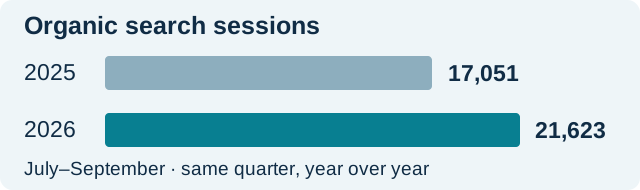
Product education and a connected buying experience give that audience somewhere useful to go.
Explore the organic traffic example →INDUSTRIAL · ORGANIC SEARCH
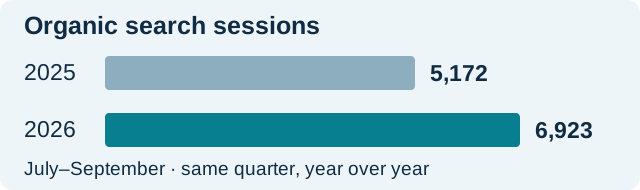
6,923 organic-search sessions in July–September 2026, compared with 5,172 a year earlier. See how technical buyer content connects with equipment research and the sales conversation.
Explore the organic traffic example →MEASURED SEARCH PERFORMANCE

705 Google search clicks in September 2026, up from 421 a year earlier. See the search performance behind this growing practice’s online visibility.
Read the example →LANDSCAPING · GOOGLE ADS

Landscaping Lawn Maintenance Plus grew from 126 ad clicks in March to 475 in April 2026, while cost per recorded conversion fell 56.9%. By July, that cost was $45.46. See the monthly results behind the campaign work.
Explore the paid-search example →LOCAL BUSINESS PROFILE · WEBSITE CARE
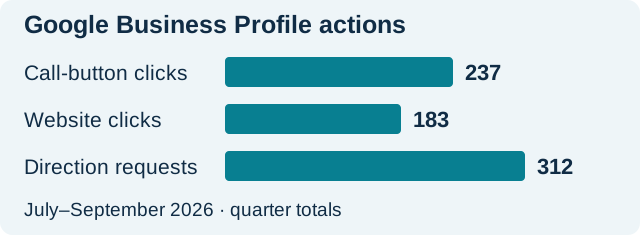
During July–September 2026, this dental practice’s Google Business Profile recorded 237 call-button clicks and 183 website clicks for this current DOYJO hosting and local SEO customer. A local-business example of the path from discovery to contact.
Explore the local visibility example →WEBSITE DESIGN · EARLY CUSTOMER SUCCESS

A recent Radius Labs website project, its product-to-inquiry path, and Craig Ranger’s customer-reported early sale.
Read the example →SEARCH EXPERIENCE · SINCE 2012
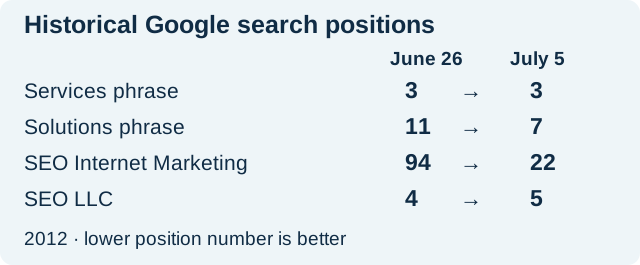
A dated ranking report and archived website show the foundations of Splinternet’s SEO and internet marketing work.
Read the example →Get started at $421/month. Month to month. Cancel at any time. Your Free SEO Plan shows the opportunities we see, the work we recommend and how we’ll measure progress.
Free SEO Plan
Tell us your goal. Your Free SEO Plan explains the opportunities, recommended improvements and how we’ll measure progress. Put our experience and DOYJO’s process to work for $421/month.
Target: within one hour. Extra research can take longer. No card. No password.
We’ll review your inquiry and follow up from hello@splinternetmarketing.com.
First, open the private sign-in link in your email. Returning later? Choose Account and request a fresh link with the same email. No password needed.
For direct correspondence
Please leave passwords and billing details out of this form. After you choose to start, Account guides you through secure access and setup.
Start with your goal, current website and available evidence. SEO improves organic discovery; paid advertising buys placements within an approved budget. Both need a clear offer and a working inquiry path. We use your proposal to choose a starting priority. Compare the SEO work with Google Ads management before deciding.
SEO helps people find your business through search engines. AIO—AI search optimization—helps search and AI systems understand and reference your expertise. We strengthen your service information, technical foundations and helpful content, then use the evidence to guide the next improvement.
Yes. The AI-written proposal explains how we would execute the services you select. There is no card requirement or subscription at this stage. You can review it and ask questions before deciding whether to start the $421 monthly service.
Splinternet Marketing is responsible for your service. You work directly with Splinternet Marketing’s frontier-model AI, trained and overseen by founder Brian Bateman. He created Splinternet Marketing to make his enterprise service experience available to small businesses. Meaningful changes and separate advertising budgets follow your agreed approvals.
Your business should control its assets. Agencies and resellers are welcome when they have the end client’s authorization. Existing accounts remain in place wherever practical. When an account must be created, we establish your ownership or administrator access, verify it works, then keep the access needed to deliver the service. Google products have different role and transfer rules, so each handoff is checked individually.
Sign in to Account, choose your business and send a request. You can follow its progress, review a proposed version and approve it or ask for changes. Prefer email? Reply to any message from hello@splinternetmarketing.com with questions, feedback or directions. Splinternet Marketing reads your replies, answers questions and follows through on your requests. Include your business name if you manage more than one.
Yes. The $421 monthly plan includes the listed management services for one managed business. You can start with SEO and add Google Ads or social management later. We update your priorities and schedule the setup in your work queue. Advertising spend and third-party products are separate costs paid to those providers.
Your proposal sets the starting priorities. We review and enhance the plan weekly, work through the agreed tasks, and use detailed monthly reporting to guide the next month. Larger projects are completed in stages. Adding services changes the mix and timing of work within the same monthly price; access, approvals and scope affect delivery.
After you authorize your plan, you grant access to the accounts relevant to the work. We confirm tracking and establish a baseline, make an agreed improvement, and review the results weekly. Detailed monthly reporting shows completed work, results, limitations and next priorities. Your accounts remain yours.
We match the customer’s search, the ad and a dedicated landing page around one useful offer. We check conversion tracking before launch, then use lead quality, cost and available sales data to improve targeting and the page. Google Ads management and landing-page work are included in your prioritized plan. Advertising spend is separate and needs approval.
We use the business goal and services you select, plus available public pages from your website. We look for useful opportunities in how your services, customer needs, location and next step are explained. Your AI-written proposal includes findings, recommended work, a first-month plan and ways to measure progress. It also explains what needs confirming. Private analytics, account performance and hands-on website checks require access later.
That is the starting goal. We first identify your website platform and connected services, then compare keeping your current setup with an approved transfer or rebuild. Platforms such as Wix cannot simply be copied as a working site onto another host. We review content, page addresses, forms, ordering tools, backups, and redirects before agreeing the scope, and prepare a private preview where appropriate.
Yes. The process includes review of the migration or rebuild scope, the private preview, and the final launch version. Ongoing changes are presented in manageable batches. Paid campaigns also require an agreed budget and campaign scope. If a proposed version changes after approval, we bring the revised work back for review.
Yes. Organic social media marketing shares useful website content and tells your business story through suitable social channels, including authorized customer accounts and relevant Splinternet Marketing-managed pages and groups. We arrange access or set up suitable missing accounts, agree the publishing plan and connect supported automation. Paid advertising management is also included; platform ad spend needs your approval and is paid separately.
You retain your domain ownership and control of your accounts. Hosting with Splinternet Marketing is optional and included where suitable. If you keep your host, we first check that the platform, permissions, and backup access let us maintain the site reliably. We document any limitations and agree on the work before starting.
Tell us which accounts you can access and who currently manages them. We first look for the existing website and marketing assets, then identify the owner or provider who can grant or restore access. A new account is created only when appropriate, rather than duplicating an existing business profile or losing useful history.
Yes. Domain-record changes are part of onboarding when needed. After you connect a supported provider, we inspect the existing records, prepare the changes, and ask you to approve the launch. The process preserves email and connected services, applies approved website records, and checks the site and HTTPS. Some providers require you to complete sign-in, two-factor authentication, or a final confirmation. Nameserver changes are reviewed separately.
Yes. You can use Splinternet Marketing to support your own customers. Each managed business has its own $421 plan, work records, access, and approvals. We confirm your authority to act for that client and who should receive questions and review requests. One reseller can work with several separate client businesses.
Yes. We identify the required steps and deadline, ask for the relevant information through an appropriate protected channel, and help prepare or submit it when Google permits delegated action and you authorize the submission. Some checks must be completed by the account holder. Google makes the final verification decision. Your advertising billing stays with Google.
Yes. Start with a free AI-written proposal for your selected services. Our target is within one hour; extra research or missing details can take longer. Review the plan before choosing the $421 monthly service. We confirm the business and billing contact before you authorize a subscription in Account.
The service is $421 USD per month per business, month to month. Cancel future renewals at any time in your account. Service continues through your paid term. Advertising spend, domains and paid outside products are separate and require your approval.
We do not buy, sell, or trade your data. Essential account and form cookies, with optional analytics you control. Our policies and service commitments →